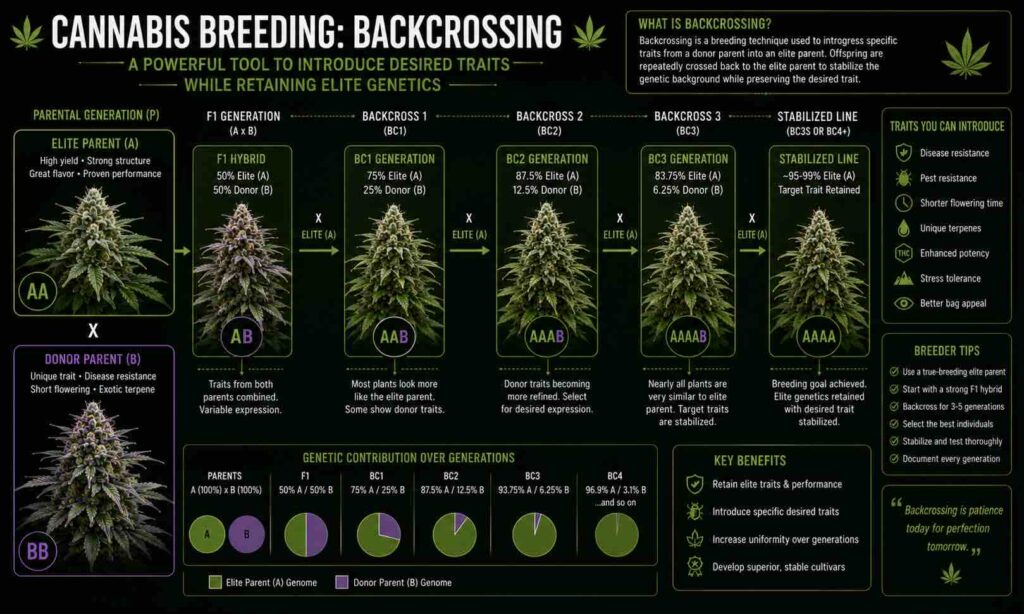
Backcrossing is one of the most important techniques used in modern cannabis breeding. While many growers are familiar with hybridization and phenotype selection, backcrossing often receives less attention despite its significant role in genetic refinement. Breeders use this method to reinforce desirable traits, improve consistency, and strengthen specific characteristics within a cultivar. Understanding backcrossing helps growers gain a deeper appreciation for the work involved in developing stable cannabis genetics.
Modern breeding projects frequently rely on multiple generations of selection and refinement. Backcrossing serves as a valuable tool within this process by allowing breeders to preserve important traits while gradually improving genetic stability.
What Is Backcrossing?
Backcrossing is a breeding technique that involves crossing an offspring back to one of its original parents or a closely related genetic line. The primary objective is to increase the likelihood that specific characteristics from the parent will be expressed in future generations.
This approach allows breeders to focus on traits they consider especially valuable. By repeatedly selecting individuals that display those traits and incorporating them into further breeding work, breeders can strengthen consistency and reduce unwanted variation.
Backcrossing is commonly used in plant breeding because it provides a structured method for refining genetics.
The technique is particularly useful when preserving unique characteristics becomes a priority.
Why Breeders Use Backcrossing
One of the main reasons breeders use backcrossing is to reinforce desirable traits within a cultivar. These characteristics may include plant structure, vigor, growth patterns, stability, terpene expression, or environmental adaptability.
Rather than relying solely on broad selection across large populations, breeders can use backcrossing to focus attention on specific objectives. This targeted approach helps create greater consistency while maintaining important genetic qualities.
Many successful cultivars have benefited from backcrossing at some stage during their development. The technique remains a valuable component of modern breeding strategies.
Consistency often improves when breeding goals are clearly defined and carefully pursued.
The Relationship Between Backcrossing and Stability
Genetic stability is one of the most important goals in cannabis breeding. Growers generally prefer cultivars that perform predictably and express reliable characteristics over multiple generations.
Backcrossing can contribute to stability by increasing the frequency of specific traits within a genetic line. However, successful stabilization requires more than a single backcross. Multiple generations of evaluation, selection, and refinement are often necessary before a cultivar achieves a high level of consistency.
Professional breeding programs typically combine backcrossing with other techniques such as phenotype selection and extensive testing.
The strongest cultivars are usually the result of long-term genetic development rather than isolated breeding events.
Potential Advantages and Limitations
Like any breeding technique, backcrossing offers both advantages and limitations. One advantage is the ability to preserve specific characteristics while improving uniformity within a population. This makes the technique useful when breeders wish to maintain valuable traits over time.
At the same time, breeders must be careful to preserve sufficient genetic diversity within their projects. Excessive focus on a narrow set of characteristics can reduce variation and limit future breeding opportunities.
Growers interested in exploring modern cannabis genetics can learn more through ww.ministryofcannabis.com. Understanding breeding techniques helps cultivators better appreciate the complexity behind professional genetic development.
Successful breeding often involves balancing consistency with diversity.
The Future of Backcrossing in Cannabis Breeding
Backcrossing continues to play an important role in contemporary breeding programs. Advances in plant science, genetic analysis, and cultivation technology provide breeders with additional tools for evaluating and refining their projects.
As breeding techniques continue evolving, backcrossing will likely remain a valuable method for preserving important characteristics and improving genetic consistency. The technique complements other breeding strategies and contributes to the ongoing development of high-quality cannabis cultivars.
Additional information regarding cannabis cultivation and educational resources can be explored through https://www.weedy.fr/blog/guides.
The continued refinement of breeding practices ensures that cannabis genetics will keep evolving for future generations of growers.
Final Thoughts
Backcrossing is a powerful breeding technique that helps preserve valuable traits and improve genetic consistency. While it represents only one part of the broader breeding process, its contribution to cultivar development is significant.
By understanding how backcrossing works, growers gain greater insight into the science and strategy behind modern cannabis breeding. The technique remains an essential tool for breeders seeking to refine genetics while maintaining the qualities that make a cultivar unique.